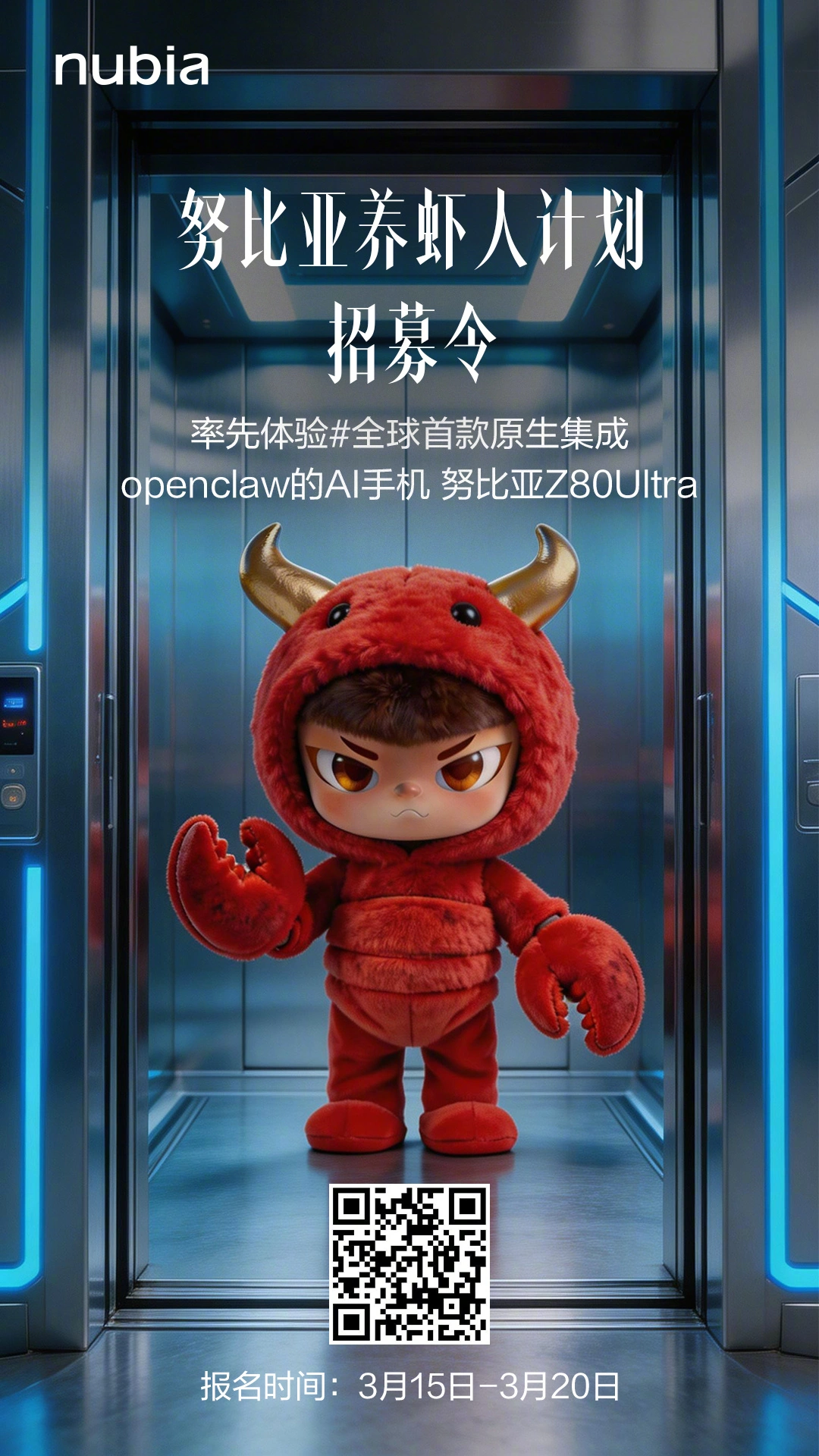
Smartphone makers are racing to integrate artificial intelligence into their devices, but most implementations still rely heavily on cloud-based services or separate AI apps. Nubia is now taking a different approach. The company has announced that the Nubia Z80 Ultra will become the world’s first smartphone to feature native OpenClaw AI integration, marking a significant step forward in how AI can interact with a mobile operating system.
To prepare for the rollout, Nubia has also introduced a new internal testing initiative called the “Nubia Shrimp Farmer Program.” Through this program, selected beta testers will get early access to the OpenClaw-powered system on the Nubia Z80 Ultra, helping the company refine the AI experience before it reaches the general public.
The move signals Nubia’s ambition to transform the smartphone into a more intelligent and proactive digital assistant capable of performing real tasks rather than simply responding to prompts.
What is OpenClaw AI?
OpenClaw is an open-source AI agent designed to go beyond traditional chatbot-style assistance. Instead of only answering questions, it is built to actively perform tasks by connecting with apps, files, and online services.
With OpenClaw, AI can handle activities such as browsing the web, managing messages, scheduling actions, and completing multi-step workflows. In simple terms, it converts AI from a passive assistant into a tool that can actually execute commands across different apps and services.
This capability allows users to automate daily tasks more efficiently. For example, the AI could gather information from the internet, organize it, and perform follow-up actions without requiring constant manual input.
Native Integration Inside the Operating System
One of the most notable aspects of the Nubia Z80 Ultra is that OpenClaw is not running as a standalone application. Instead, Nubia is embedding the AI directly into the phone’s operating system.
This deeper integration allows the AI to interact with apps, settings, and system-level functions more naturally. Rather than switching between apps or relying on cloud services, the AI can execute tasks within the device environment itself.
According to Ni Fei, President of the ZTE Terminal Business Unit and President of Nubia Technology, the Nubia Z80 Ultra represents a new category of “Gateway-type AI phone.”
The device supports ClawBot scenario-based applications and provides access to a broader Skills ecosystem, enabling users to automate workflows that involve multiple services or apps. This approach could make AI interactions faster, more responsive, and more useful in everyday scenarios.
Nubia Shrimp Farmer Program for Beta Testing
To fine-tune the AI integration, Nubia is launching the Nubia Shrimp Farmer Program, which invites early adopters and enthusiasts to test OpenClaw AI on the Nubia Z80 Ultra.
Participants in the program will be able to explore the system before the official public rollout. Their feedback will help Nubia identify bugs, improve performance, and refine the AI’s real-world functionality.
Beta programs like this are increasingly common for advanced software features, especially when companies are introducing new technologies that require real-world testing across diverse user scenarios.
Nubia Z80 Ultra Specifications and Hardware
The Nubia Z80 Ultra is designed as a flagship smartphone, and its hardware reflects that positioning.
The device is powered by the Snapdragon 8 Ultra (5th generation) processor, which provides the performance required for demanding tasks such as AI processing, gaming, and advanced photography.
On the camera front, Nubia has equipped the phone with a 50MP 35mm “Master Eye” main camera featuring a large 1/1.3-inch sensor. The camera system also supports DCG dual conversion gain HDR technology, which improves dynamic range and image clarity in challenging lighting conditions.
For photography enthusiasts, Nubia also offers an optional photography kit that expands the device’s imaging capabilities.
The Nubia Z80 Ultra originally launched on October 22 and is priced starting at 4,999 yuan, which is roughly $730.
Why This Matters for Users
The integration of OpenClaw AI could represent a major shift in how people interact with smartphones. Instead of manually switching between apps and performing repetitive tasks, users may soon rely on AI to manage workflows automatically.
Because the AI is embedded directly into the operating system, it can potentially deliver faster responses and deeper control over the device. Tasks that typically require multiple steps—such as organizing schedules, gathering information, or managing messages—could be handled more efficiently.
If the technology performs as expected, it may influence how other smartphone manufacturers approach AI integration in future devices. Rather than treating AI as a standalone feature, companies could start building it directly into the core system experience.
Final Thoughts
The Nubia Z80 Ultra’s native OpenClaw AI integration highlights how quickly smartphone technology is evolving. By embedding an open-source AI agent directly into the operating system, Nubia is exploring a more advanced way for users to interact with their devices.
While the real impact will depend on how well the AI performs in everyday use, the concept itself is promising. If successful, it could pave the way for smartphones that do far more than respond to commands—they could actively help manage tasks, automate routines, and simplify digital life.
With the Shrimp Farmer beta testing program now underway, it will be interesting to see how the OpenClaw ecosystem develops and whether Nubia’s experiment sets a new direction for AI-powered smartphones.
Via: (Source)