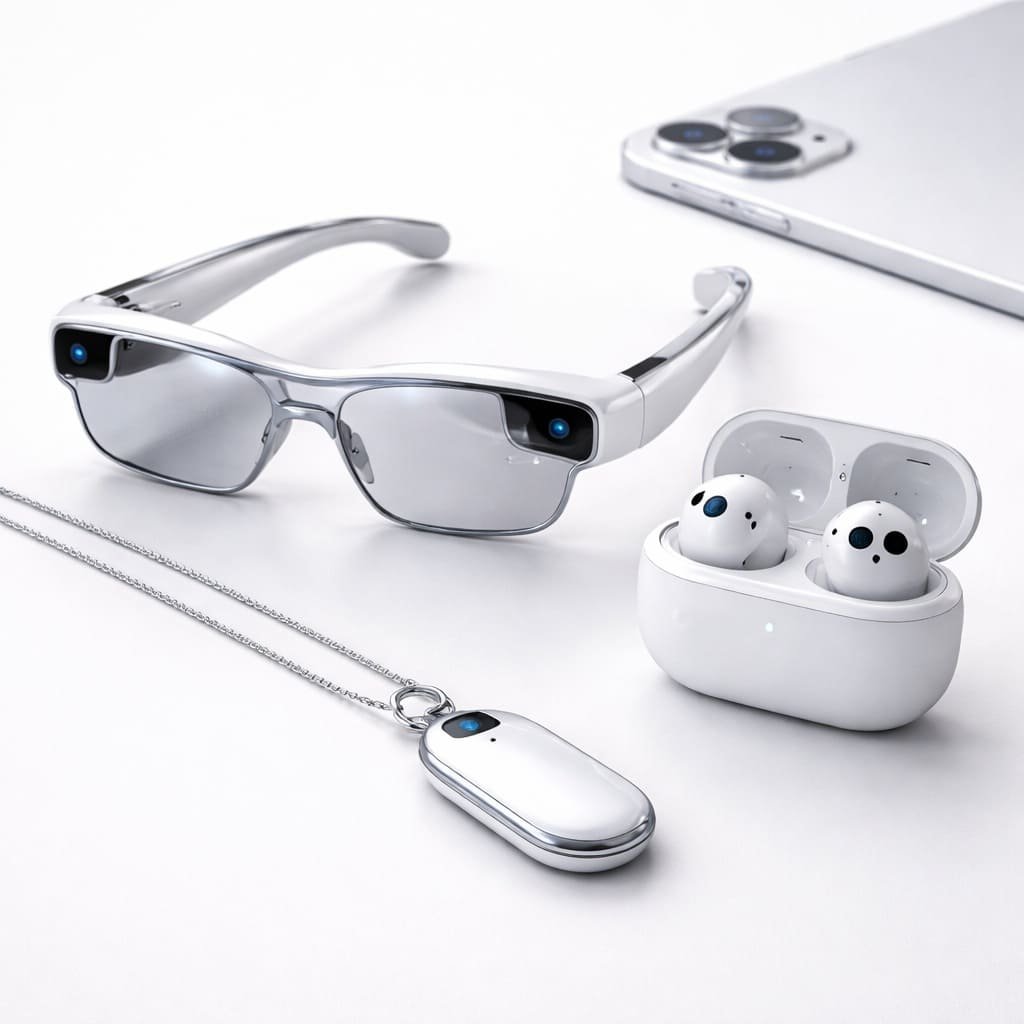
A new report from Bloomberg's Mark Gurman suggests that Apple is exploring three new wearable devices designed to expand its ecosystem and strengthen the role of artificial intelligence in everyday life. The company is reportedly developing smart glasses, AirPods equipped with cameras and enhanced AI features, and a wearable AI pendant that can be clipped to clothing or worn as a necklace.
All three devices are said to revolve around Siri, Apple’s digital assistant, and will rely on visual context to interpret surroundings and perform actions. Each product is expected to pair with an iPhone, using built-in cameras and microphones to feed environmental data into AI-powered features.
According to the report, Apple’s next generation of wearables is being designed to function as an extension of the iPhone. While all three devices will include cameras, the AirPods and pendant will reportedly use low-resolution sensors intended only to assist AI recognition rather than capture photos or videos. The smart glasses, however, are expected to feature more advanced imaging hardware.
During a recent company-wide meeting, Apple CEO Tim Cook reportedly emphasized that the “world is changing fast,” highlighting Apple’s investment in AI-powered product categories that could define the company’s future.
Apple’s rumored smart glasses are expected to be the most sophisticated of the three devices. Unlike augmented reality headsets such as the Apple Vision Pro, the glasses will not include a display. Instead, they will integrate speakers, microphones, and cameras to provide real-time assistance through audio feedback.
The glasses are said to include two cameras: one for high-resolution imagery and another dedicated to computer vision. This second sensor will analyze surroundings and measure distances between objects, similar to environmental awareness technology used in Apple’s spatial computing platform.
The goal is to create an all-day AI companion capable of understanding what users see and offering contextual help. For example, users could look at an object and ask what it is, add event details from a poster directly to their calendar, or receive reminders triggered by real-world cues. For navigation, Siri may reference landmarks instead of street names, guiding users with instructions based on visible surroundings.
Apple is also reportedly aiming to differentiate its glasses from competitors such as Meta’s Ray-Ban smart glasses by offering improved camera quality, premium build materials, and frames developed in-house in multiple sizes and colors.
Another device under development is a future version of AirPods featuring cameras and enhanced AI functionality. These sensors are not meant for photography but will help Siri interpret visual context and respond more intelligently to user requests.
By combining spatial awareness with voice commands, the AI-enabled AirPods could support real-time translation, contextual notifications, and smarter voice assistance that understands the user’s environment.
Apple is also reportedly experimenting with a wearable AI pendant designed to be clipped onto clothing or worn as a necklace. The device would act as an always-on camera and microphone for the iPhone, providing continuous environmental awareness for Siri.
Unlike standalone AI devices such as the Humane AI Pin, Apple’s pendant is expected to function strictly as an iPhone accessory rather than a replacement. Some employees have reportedly described it as the “eyes and ears” of the iPhone.
The pendant is said to have limited processing power — closer to AirPods than an Apple Watch — reinforcing its role as a sensor hub rather than an independent computing device.
Both the smart glasses and AI pendant are reportedly targeted for release next year, provided development continues as planned. The AirPods with enhanced AI capabilities are also under active development, though timelines may shift as Apple refines its strategy.
Apple’s push into AI-driven wearables reflects a broader industry shift toward ambient computing, where technology quietly integrates into everyday life. By enabling devices to see, hear, and interpret the user’s environment, Apple aims to make digital assistance more proactive and context-aware.
However, questions remain about practicality and privacy, as well as whether these devices offer significant advantages over smartphones and smartwatches. Much will depend on execution — particularly design, battery life, and the evolution of Siri into a truly intelligent assistant.
If the report proves accurate, Apple’s upcoming wearables could mark a significant step toward AI-powered, context-aware computing. Smart glasses designed as an all-day assistant, camera-enabled AirPods that understand surroundings, and an AI pendant acting as a sensory extension of the iPhone all point toward a future where devices work quietly in the background to simplify daily tasks.
Whether these products become essential tools or niche experiments will depend on how effectively Apple balances usefulness, privacy, and seamless integration. As the company searches for its next breakthrough category, the success of these AI-driven wearables may ultimately hinge on delivering meaningful convenience in a form people truly want to wear.
Via: (Source - 1, 2), Image Credits: Representative Image Created using AI
To know more about our platform, visit our About Us page.


Comments