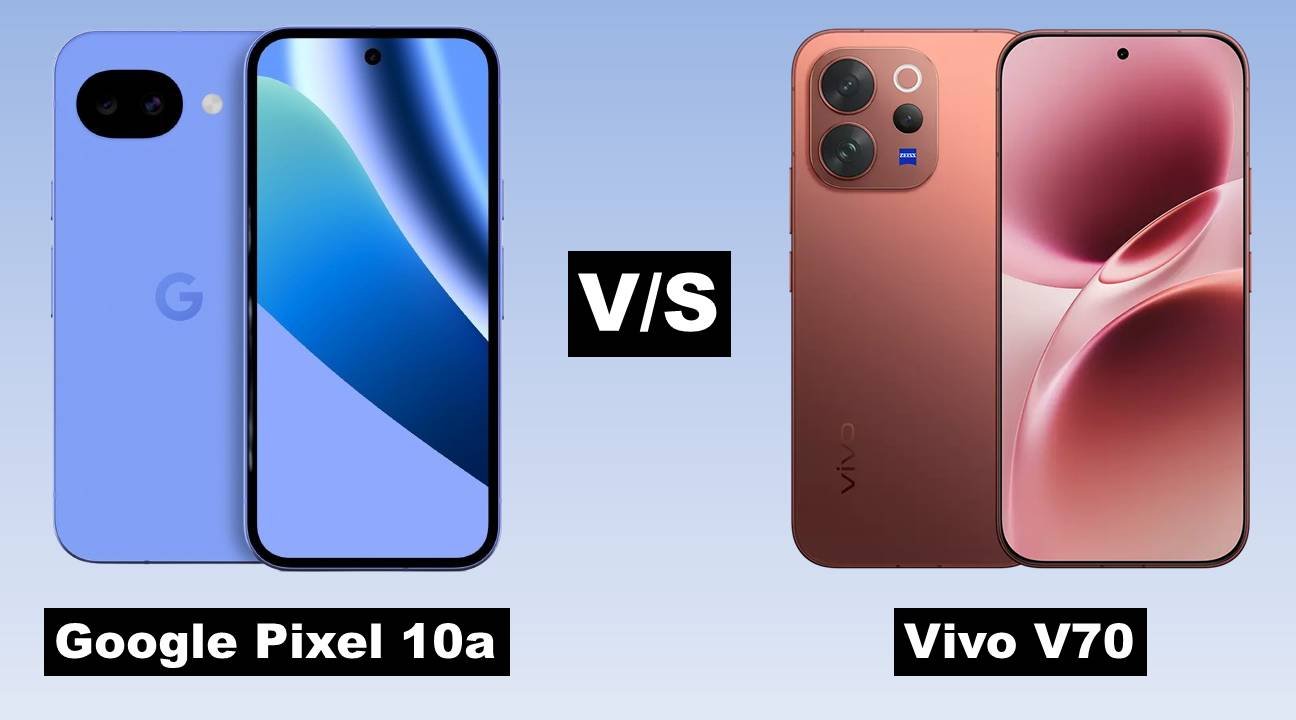
The mid-range smartphone segment continues to evolve rapidly, with brands pushing premium features into more affordable price ranges. Google has introduced the Pixel 10a with a focus on software intelligence, camera reliability, and long-term updates, while Vivo is targeting performance enthusiasts and multimedia users with the feature-packed Vivo V70.
Both devices arrive in early 2026 and compete in a similar price bracket in India, making the choice between them less about cost and more about priorities. If you value photography and software longevity, one may suit you better; if you prefer raw power, fast charging, and advanced camera hardware, the other could be the stronger pick.
The Pixel 10a maintains Google’s clean and minimal design language. It features Gorilla Glass 7i on the front, an aluminum frame, and a durable plastic back. With a weight of 183 grams and a thickness of 9 mm, it feels sturdy and comfortable in hand. The IP68 rating ensures protection against dust and water immersion.
The Vivo V70, by contrast, feels more premium and modern. It features a glass front paired with either a glass back or fiber-reinforced plastic back, supported by an aluminum alloy frame. The device is noticeably slimmer at around 7.4–7.6 mm, though slightly heavier. It carries IP68/IP69 protection, meaning it can withstand high-pressure water jets in addition to immersion.
Users who prefer a sleek and premium feel may lean toward the Vivo V70, while those who value practicality and durability will appreciate the Pixel 10a’s solid construction.
Display technology is one of the most noticeable differences between these two phones.
The Pixel 10a offers a 6.3-inch P-OLED display with HDR support and a 120Hz refresh rate. It delivers excellent color accuracy and reaches up to 3000 nits peak brightness, ensuring clear visibility outdoors.
The Vivo V70 steps ahead in visual impact with a larger 6.59-inch AMOLED display supporting HDR10+ and an impressive peak brightness of 5000 nits. The higher resolution and pixel density make content appear sharper, while the near-edge-to-edge screen design enhances immersion.
For streaming, gaming, and outdoor usage, the Vivo V70 delivers a more striking visual experience, though the Pixel 10a remains excellent for everyday use.
Both smartphones run Android 16, but their approach to performance and long-term usability differs.
The Pixel 10a is powered by Google’s Tensor G4 chipset, designed to enhance AI processing, voice recognition, and computational photography. It is optimized for a smooth, intelligent user experience rather than raw benchmark dominance. A major advantage is Google’s commitment to seven years of Android upgrades, ensuring longevity and security updates well into the future.
The Vivo V70 runs on the Snapdragon 7 Gen 4 processor, paired with faster UFS 4.1 storage and up to 12GB RAM. This setup delivers strong multitasking performance, faster data access, and excellent gaming capability. However, Vivo promises four major Android updates, which is significantly less long-term support compared to Google.
If you want a phone that stays updated for years, the Pixel 10a leads. If performance and speed are top priorities, the Vivo V70 holds an edge.
Camera performance is a defining strength for both devices, but they target different photography styles.
The Pixel 10a features a 48MP primary camera and a 13MP ultrawide lens. Google’s computational photography, including Ultra HDR and Best Take, ensures consistently excellent results with accurate colors and strong low-light performance. It’s built for point-and-shoot reliability.
The Vivo V70 offers a more versatile triple-camera setup. It includes a 50MP main sensor, a 50MP periscope telephoto lens with 3.7x optical zoom, and an 8MP ultrawide camera. ZEISS optics and advanced imaging features enhance portrait photography and zoom clarity.
Selfie lovers will also appreciate the Vivo V70’s 50MP autofocus front camera, which significantly outclasses the Pixel 10a’s 13MP shooter.
If you prefer effortless photography with dependable results, the Pixel 10a excels. If you want zoom capabilities, portrait depth, and high-resolution selfies, the Vivo V70 stands out.
The Pixel 10a includes Wi-Fi 6E, Bluetooth 6.0, NFC, and Satellite SOS support — a safety feature enabling emergency communication when cellular coverage is unavailable.
The Vivo V70 includes Bluetooth 5.4, NFC, and an infrared port for controlling home appliances. It also features an ultrasonic fingerprint sensor, which is generally faster and more reliable than optical sensors.
Both devices support global navigation systems, ensuring accurate location tracking.
Battery performance is another major differentiator.
The Pixel 10a packs a 5100 mAh battery that comfortably lasts a full day. It supports 30W wired charging and 10W wireless charging, offering convenience for everyday use.
The Vivo V70 pushes endurance further with a massive 6500 mAh silicon-carbon battery. Combined with 90W fast charging, the device can recharge extremely quickly. Reverse wired charging is also supported, allowing it to power other devices.
For heavy users and fast charging needs, the Vivo V70 is clearly superior, while the Pixel 10a balances battery life with wireless charging convenience.
The Pixel 10a starts at ₹49,999 in India, positioning it as a premium mid-range device with long-term value.
The Vivo V70 starts at ₹45,999, offering more hardware features at a slightly lower price, making it appealing for users seeking performance and camera versatility.
The Pixel 10a and Vivo V70 cater to different types of users despite sharing a similar price range.
The Pixel 10a is ideal for users who prioritize software longevity, consistent photography, AI-driven features, and a clean Android experience. Its seven-year update promise makes it a long-term companion.
The Vivo V70, on the other hand, delivers a more feature-packed hardware experience. Its brighter display, zoom camera system, faster charging, larger battery, and powerful performance make it an excellent choice for multimedia enthusiasts and power users.
Choosing between them ultimately depends on what matters most: long-term reliability and software excellence, or cutting-edge hardware and performance.
To know more about our platform, visit our About Us page.


Comments