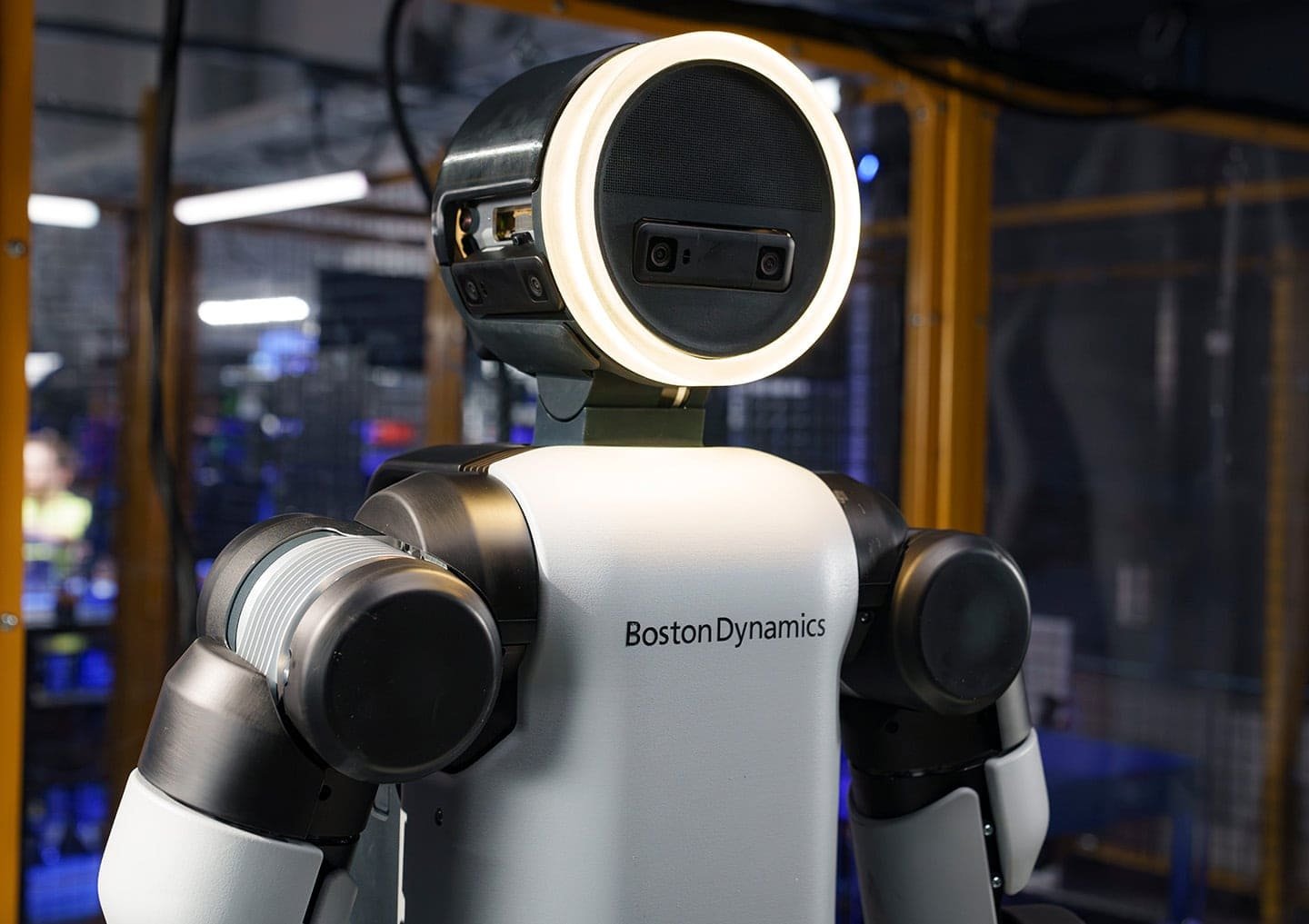
At the Consumer Electronics Show in Las Vegas, Hyundai Motor Group–owned Boston Dynamics officially unveiled the product-ready version of its new Atlas robot. Revealed during Hyundai’s global CES media day presentation, the fully electric humanoid marks a major milestone for the robotics industry. The event also featured a live on-stage demonstration of the Atlas prototype, alongside an energetic dance performance by Boston Dynamics’ iconic Spot robots, capturing both the technical prowess and creative spirit behind the company’s vision.
The new Atlas represents Boston Dynamics’ most advanced humanoid robot to date. Built as an enterprise-grade solution, Atlas is designed to perform a wide range of industrial tasks including material handling, order fulfillment, and complex logistics operations. Unlike experimental concepts, this version of Atlas is production-ready and purpose-built for deployment in real industrial environments.
Boston Dynamics confirmed that production of the new Atlas robots will begin immediately at its Boston headquarters. All Atlas deployments for 2026 are already fully committed, with initial fleets scheduled to ship to Hyundai’s Robotics Metaplant Application Center and Google DeepMind in the coming months. Additional customers are expected to be added in early 2027.
Boston Dynamics CEO Robert Playter described the new Atlas as a defining moment for the company. He emphasized that this robot represents more than three decades of innovation in advanced robotics. According to Playter, Atlas is not only the best robot Boston Dynamics has ever built, but also the first major step toward a long-term vision of creating useful robots that can one day assist people in everyday life.
The focus, however, remains firmly on industrial applications for now, where Atlas is expected to dramatically improve safety, productivity, and operational efficiency.
Atlas is designed to work with minimal supervision while maintaining consistent and reliable performance. The robot can quickly learn new tasks, adapt to dynamic environments, and operate autonomously across complex workflows. Once a single Atlas robot learns a new task, that capability can instantly be shared across the entire fleet, allowing rapid scaling of operations.
The robot supports multiple control methods, including full autonomous operation, teleoperation, and a tablet-based steering interface. This flexibility allows businesses to deploy Atlas in a variety of scenarios, from fully automated facilities to environments that require human oversight.
One of Atlas’ standout features is its ability to operate continuously without downtime interruptions. When battery power runs low, the robot can autonomously navigate to a charging station, swap its own batteries, and return to work without human intervention.
Physically, Atlas is engineered for demanding tasks. It features 56 degrees of freedom, fully rotational joints, and an impressive reach of up to 2.3 meters. The robot can lift loads of up to 50 kilograms, making it suitable for heavy industrial applications. It is also highly water-resistant and capable of operating in temperatures ranging from -20°C to 40°C, ensuring reliability across diverse working conditions.
Atlas is designed to integrate easily into existing industrial environments. Using Boston Dynamics’ Orbit software, the robot can connect to manufacturing execution systems, warehouse management systems, and other enterprise platforms. It also supports integration with barcode scanners and RFID systems, allowing it to fit naturally into modern logistics and production workflows.
Safety is a core part of Atlas’ design, with features such as human detection and fenceless guarding that allow the robot to operate safely alongside human workers.
Boston Dynamics has emphasized that the new Atlas is its most production-friendly robot yet. Zack Jackowski, General Manager of Atlas, highlighted that this generation significantly reduces the number of unique parts and has been designed for compatibility with automotive supply chains. With Hyundai Motor Group’s backing, the company aims to achieve industry-leading reliability and economies of scale.
Hyundai Mobis will supply the actuators for Atlas, and both organizations will work together to build a robust and scalable component supply chain while accelerating actuator development and production.
Alongside the product unveiling, Boston Dynamics announced a new partnership with Google DeepMind. The collaboration will focus on integrating advanced Google DeepMind foundation models into Atlas, enhancing the robot’s cognitive capabilities. This partnership is expected to enable more sophisticated decision-making, improved perception, and greater adaptability in complex industrial environments.
With the launch of the new Atlas robot at CES, Hyundai Motor Group and Boston Dynamics have taken a major step toward reshaping the future of industrial automation. Atlas combines advanced humanoid mobility, intelligent autonomy, and production-ready design in a way few robots have achieved before.
From heavy lifting and logistics to seamless system integration and continuous operation, Atlas is built to deliver real value at scale. As deployments begin in 2026 and partnerships expand, the new Atlas stands poised to redefine how industry works and brings the vision of truly useful humanoid robots closer to reality.
Via: (Source)
To know more about our platform, visit our About Us page.


Comments