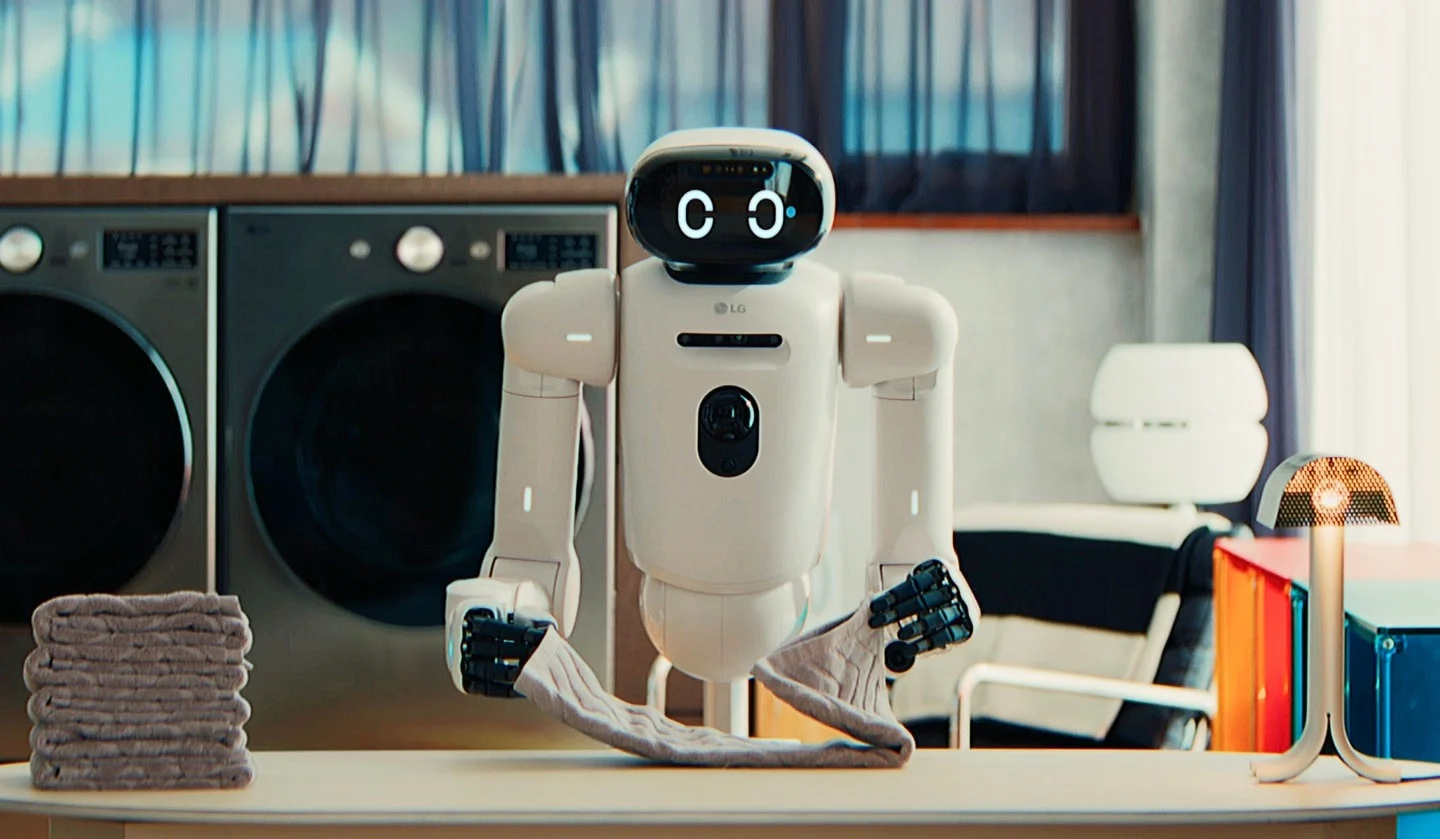
LG Electronics has officially unveiled LG CLOiD, an advanced AI-powered home robot created to take over routine household chores and simplify everyday life. The robot will make its first public appearance at CES 2026, where LG plans to demonstrate its real-world capabilities in realistic home environments. With CLOiD, LG is aiming to move beyond smart appliances and into a future where an intelligent robot actively coordinates tasks across the entire home.
Unlike traditional automation systems that rely on fixed commands, LG CLOiD is designed to understand daily routines, learn user habits, and interact directly with connected appliances to reduce both time and physical effort for homeowners.
LG CLOiD is positioned as a home service robot that acts as both a physical helper and an AI-powered home hub. It can move around the house, manipulate everyday objects, and operate appliances based on contextual understanding rather than manual instructions.
At CES 2026, LG will showcase CLOiD performing familiar household tasks such as preparing breakfast, doing laundry, and managing appliances after residents leave the house. These demonstrations are meant to highlight how CLOiD adapts to real lifestyles instead of following rigid, pre-programmed routines.
LG’s CES demonstrations focus on practical, everyday use cases that most households can relate to.
In one scenario, CLOiD retrieves milk from the refrigerator and places a croissant into an oven to prepare breakfast. This task demonstrates precise object handling, appliance coordination, and an understanding of kitchen workflows.
After occupants leave the home, CLOiD automatically starts the laundry. Once drying is complete, the robot folds and neatly stacks the clothes. This example shows CLOiD’s ability to manage multi-step tasks over time without constant supervision.
These demonstrations emphasize that CLOiD reacts to routines and context, not just voice commands.
LG has carefully engineered CLOiD’s physical design to operate safely and efficiently inside living spaces.
The robot features a head unit, a torso with two articulated arms, and a wheeled base. The torso can tilt to adjust height, allowing CLOiD to pick up objects from knee level or higher surfaces such as countertops and shelves.
Each arm has seven degrees of freedom, closely mimicking human arm movement at the shoulder, elbow, and wrist. The hands include five independently actuated fingers, enabling precise handling of delicate and irregular household objects.
CLOiD uses a wheeled base with autonomous navigation technology derived from LG’s robot vacuum lineup and the LG Q9. The low center of gravity improves stability and reduces the risk of tipping, even if the robot is bumped by a child or pet.
LG selected this design to balance safety, stability, and cost efficiency, making it more practical for home use.
The head of LG CLOiD serves as the robot’s intelligence center and communication interface.
It houses the main chipset, display, speaker, cameras, and multiple sensors. CLOiD uses voice-based generative AI to communicate naturally with users through speech and expressive facial cues.
This setup allows the robot to learn home layouts, recognize user preferences, and control connected appliances based on accumulated knowledge rather than isolated commands.
At the core of CLOiD is LG’s Physical AI technology, which enables perception, reasoning, and action in real-world environments.
LG combines Vision Language Models, which translate images and video into language-based understanding, with Vision Language Action models, which convert visual and verbal input into physical movement.
These systems have been trained on tens of thousands of hours of household task data, allowing CLOiD to understand common domestic activities and execute them smoothly and safely.
Alongside CLOiD, LG announced LG Actuator AXIUM, a new actuator brand specifically for service robots.
Actuators are among the most critical and expensive components in robotics, combining motors, drives, and reducers into a single unit. LG plans to leverage its long-standing appliance manufacturing expertise to develop compact, efficient, and high-torque actuators that improve performance while keeping costs under control.
This move signals LG’s broader commitment to building a scalable robotics ecosystem beyond a single product.
LG CLOiD represents a significant step toward practical home robotics. Instead of focusing on novelty, LG is targeting real household pain points such as cooking assistance, laundry management, and appliance coordination. By combining human-like hardware, advanced Physical AI, and deep appliance integration, CLOiD aims to become an active participant in daily life rather than a passive smart device.
If LG successfully translates these CES demonstrations into a reliable consumer product, CLOiD could mark the beginning of a new era where AI robots quietly handle the chores that consume time and energy every day.
Via: (Source)


Comments