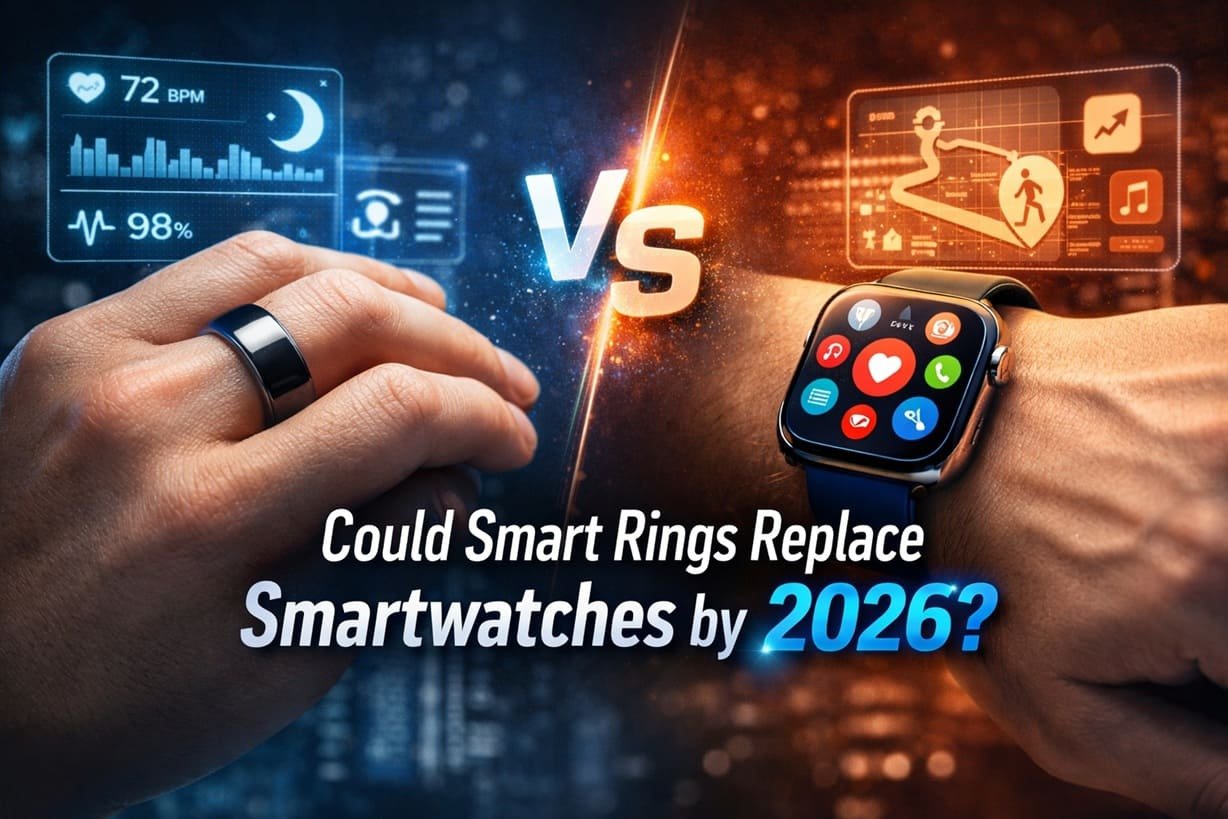
Wearable technology has evolved rapidly over the past decade. What started with bulky fitness bands has now expanded into advanced smartwatches and, more recently, ultra-compact smart rings. As smart rings gain popularity for their minimalist design and health-focused features, a big question is emerging in the tech world: Could smart rings replace smartwatches by 2026?
This article takes a realistic, balanced look at where smart rings stand today, how they compare with smartwatches, and whether they truly have the potential to take over the wrist by 2026.
Smart rings are not entirely new, but they have recently gained serious attention thanks to improved sensors, longer battery life, and growing interest in discreet wearables. Brands like Oura, Samsung, and Ultrahuman have shown that powerful health tracking can exist in a device small enough to wear on a finger.
Unlike smartwatches, smart rings focus less on notifications and more on passive health monitoring, making them appealing to users who want insights without distractions.
Modern smart rings are surprisingly capable when it comes to health data. Most premium models can track sleep quality, heart rate, heart rate variability, blood oxygen levels, stress, and activity levels throughout the day. Because rings sit close to arteries, they often provide highly accurate biometric readings.
One of the biggest strengths of smart rings is battery life. While many smartwatches need daily or every-other-day charging, smart rings can last between 4 to 7 days on a single charge. This makes them ideal for continuous health tracking, especially during sleep.
Smart rings are lightweight and subtle. They don’t light up, vibrate constantly, or demand attention. For users who prefer a “set it and forget it” experience, this is a major advantage over smartwatches.
Smartwatches offer full-color displays, touch controls, and quick access to notifications, calls, messages, and apps. Smart rings, by design, lack screens, which limits real-time interaction.
For workouts, smartwatches remain superior. Built-in GPS, workout modes, live stats, and on-screen coaching are features that smart rings simply cannot replicate yet.
Smartwatches are deeply integrated into smartphone ecosystems like Apple, Android, and Wear OS. From payments and music control to navigation and third-party apps, smartwatches function as mini-computers on the wrist.
Smart rings often match or even outperform smartwatches in sleep and recovery tracking. Their snug fit allows for consistent data collection, especially overnight.
Smartwatches are better for active daytime use, while smart rings excel in background monitoring. Many users already remove smartwatches at night, which is where smart rings shine.
Smart rings look like jewelry rather than gadgets. This makes them suitable for formal occasions, workplaces, and users who dislike bulky wearables.
The next two years are crucial for wearable innovation. Sensor miniaturization, AI-driven health insights, and improved battery technology are advancing quickly. By 2026, smart rings are expected to:
However, replacing smartwatches entirely is a much bigger challenge.
The short answer is no, not completely.
Smart rings are more likely to complement smartwatches rather than replace them. Many users may wear a smart ring for health tracking and sleep monitoring, while relying on a smartwatch for workouts, navigation, and communication.
Different use cases require different tools, and smartwatches still offer versatility that smart rings cannot match.
People who want health insights without screens or notifications may prefer smart rings.
Those primarily interested in sleep, recovery, and long-term health trends may find smart rings more comfortable and practical.
Smart rings blend seamlessly with formal wear and don’t stand out as tech devices.
Smart rings are not likely to replace smartwatches entirely by 2026, but they will become a mainstream wearable category. Their strength lies in passive health tracking, comfort, and long battery life, while smartwatches will continue to dominate active use, fitness tracking, and daily smart features.
The future of wearables isn’t about one device replacing another. It’s about choice. By 2026, users will choose smart rings, smartwatches, or both, depending on their lifestyle, priorities, and how they want technology to fit into their daily lives.
Image Credits: Created by ChatGPT using DALL·E (OpenAI).
To know more about our platform, visit our About Us page.


Comments