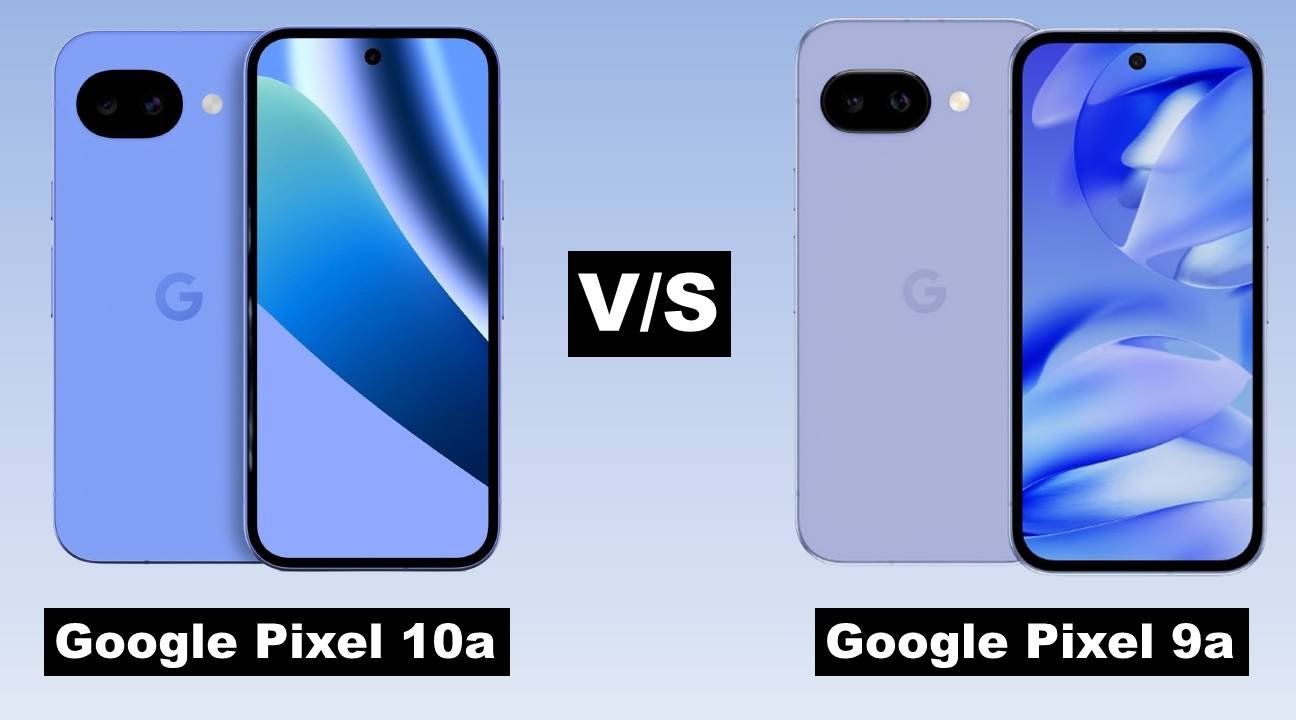
Google continues to refine its mid-range smartphone lineup with the introduction of the Pixel 10a. While the Pixel 9a already delivered a strong balance of performance, camera quality, and long-term software support, the new Pixel 10a builds on that foundation with improvements in display brightness, durability, connectivity, and charging speeds.
If you’re considering an upgrade or deciding between these two devices, understanding their differences can help you choose the one that best suits your needs.
At first glance, both phones share a familiar Pixel design language with clean lines and a practical construction. However, there are subtle refinements in the Pixel 10a.
The Pixel 10a features a glass front protected by Gorilla Glass 7i, paired with an aluminum frame and plastic back. The Pixel 9a, while also sturdy, uses Gorilla Glass 3, which offers less resistance to scratches and impacts compared to the newer protection.
Dimensionally, both devices feel similar in hand, though the Pixel 10a is slightly slimmer and lighter. Both models carry an IP68 rating, meaning they are protected from dust and can withstand water immersion up to 1.5 meters for 30 minutes.
Color choices differ slightly. The Pixel 10a arrives in Obsidian, Fog, Berry, and Lavender, while the Pixel 9a comes in Obsidian, Porcelain, Iris, and Peony.
Both phones feature a 6.3-inch P-OLED display with HDR support and a smooth 120Hz refresh rate, delivering fluid scrolling and vibrant visuals.
The Pixel 10a improves outdoor usability with higher brightness levels, reaching 2000 nits in high brightness mode and peaking at 3000 nits. The Pixel 9a, while still bright, peaks at 2700 nits with 1800 nits in high brightness mode. In everyday use, the Pixel 10a provides better visibility under harsh sunlight.
Resolution and pixel density remain identical, ensuring sharp text and detailed images on both devices.
Both smartphones are powered by the Google Tensor G4 chipset built on a 4nm architecture, ensuring similar performance levels in multitasking, gaming, and AI-driven features.
The Pixel 10a ships with Android 16 out of the box, while the Pixel 9a launched with Android 15 and is upgradeable to Android 16. Importantly, both devices promise up to seven major Android updates, making them excellent choices for users who value long-term software support.
Memory configurations are identical, offering 8GB RAM paired with either 128GB or 256GB of UFS 3.1 storage.
Photography remains one of the strongest reasons to choose a Pixel device, and both phones share the same camera hardware.
They feature a 48-megapixel primary camera with optical image stabilization and a 13-megapixel ultrawide lens with a 120-degree field of view. Google’s computational photography enhancements such as Ultra HDR, Pixel Shift, and Best Take help deliver consistently impressive results.
Video capabilities are also identical, supporting 4K recording at up to 60 frames per second and high-frame-rate slow-motion recording.
On the front, both devices include a 13-megapixel ultrawide selfie camera capable of 4K recording and HDR support.
Connectivity is largely similar, with both phones supporting 5G, Wi-Fi 6E, NFC, and USB Type-C 3.2.
However, the Pixel 10a introduces Bluetooth 6.0, offering improved efficiency and connectivity compared to Bluetooth 5.3 on the Pixel 9a. The Pixel 10a also adds Satellite SOS support, enabling emergency communication in areas without cellular coverage — a potentially lifesaving feature for travelers and outdoor users.
Both devices include an under-display fingerprint sensor and comprehensive global navigation support including NavIC.
Stereo speakers are present on both models, delivering clear and balanced audio for media playback. Neither device includes a 3.5mm headphone jack, reflecting the shift toward wireless audio solutions.
Both phones are equipped with a 5100 mAh battery designed to provide full-day usage.
Charging is where the Pixel 10a takes a noticeable step forward. It supports 30W wired charging, capable of reaching 50% in about 30 minutes, along with 10W wireless charging. The Pixel 9a supports slower 23W wired charging and 7.5W wireless charging.
Both models support bypass charging, which helps reduce heat buildup during extended use while plugged in.
The Pixel 10a starts at $499 in the United States, while the Pixel 9a launched at a lower starting price of $409.99. The price difference reflects the newer model’s improvements in durability, brightness, connectivity, and charging speed.
For budget-conscious buyers, the Pixel 9a remains a strong value option. However, users seeking the latest refinements and additional safety features may find the Pixel 10a worth the extra cost.
The Pixel 9a remains an excellent mid-range smartphone with strong performance, reliable cameras, and long-term software support. However, the Pixel 10a refines the experience with a brighter display, stronger glass protection, faster charging, improved Bluetooth technology, and Satellite SOS capability.
For current Pixel 9a users, the upgrade may not feel essential unless the improved durability and safety features are important. For new buyers, the Pixel 10a represents the more future-ready choice, offering subtle but meaningful improvements that enhance everyday usability and longevity.
To know more about our platform, visit our About Us page.


Comments