
When OpenAI first showed off Sora in 2024, it didn’t just look impressive—it felt like a glimpse into the future. Type a simple prompt, and within moments, you’d get a surprisingly realistic video clip. It was the kind of demo that made people stop scrolling and say, “Wait, this is real?”
Fast forward less than two years, and things are heading in a very different direction.
A Sudden Shift in Strategy
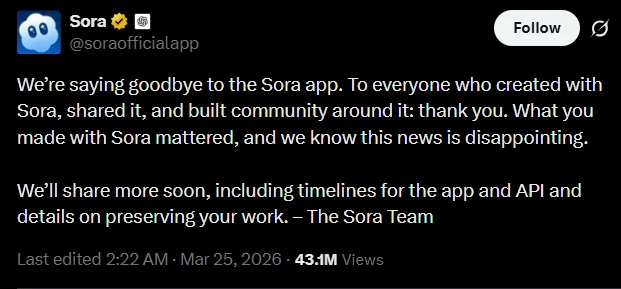
OpenAI is now reportedly stepping away from Sora, its much-hyped AI video generation tool. This isn’t a dramatic overnight shutdown, but more of a slow fade. Development is being wound down, and the app itself is no longer a priority.
Interestingly, Sora hasn’t completely disappeared yet. The web version is still accessible for now, and there’s no hard deadline for when it will go offline. It’s more like the project has been moved to the back shelf—still there, but clearly not where the company’s energy is going anymore.
Instead, OpenAI is redirecting its focus toward areas like robotics and “agentic AI.” In simple terms, that means building systems that can take actions and complete tasks with minimal human input. Think less “create a video for me” and more “handle this entire workflow on your own.”
From Viral Demos to Lukewarm Adoption
Sora had a strong start. Early demonstrations spread quickly online, with people amazed at how fast the quality improved. The tool showed real potential, especially for creators, marketers, and filmmakers.
But hype doesn’t always translate into long-term success.
Despite all the attention, Sora struggled to build serious commercial momentum. Reports suggest it generated around $1.4 million in global in-app revenue. That might sound decent at first glance, but compared to the massive success of ChatGPT—bringing in roughly $1.9 billion over a similar period—it’s a drop in the ocean.
That gap likely made it harder for OpenAI to justify continued investment, especially in a space that’s expensive to run.
The Disney Deal That Never Took Off
One of the more surprising parts of this story is the collapse of OpenAI’s partnership with The Walt Disney Company.
The deal, reportedly valued at around $1 billion, would have allowed users to generate videos featuring popular Disney characters using Sora. It sounded like a huge step toward mainstream adoption.
But things never really got off the ground.
No payments were made, and the partnership didn’t progress far enough to deliver anything meaningful. Reports suggest Disney wasn’t expecting such a sudden shift from OpenAI. Since then, the company has indicated it will continue exploring AI collaborations—but with a sharper focus on protecting its intellectual property.
The Bigger Problems Behind the Scenes
Sora’s challenges weren’t just about money or partnerships. There were deeper issues that made the platform harder to sustain.
Moderation was a constant concern. Tools like Sora can be misused to create deepfakes, replicate copyrighted material, or generate non-consensual content. Managing that at scale isn’t just difficult—it’s risky.
On top of that, the competition has been heating up. Other companies have been rolling out their own AI video tools, often with fewer restrictions or different approaches. That makes it tougher for any single platform to dominate.
And then there’s the cost. Generating high-quality video using AI isn’t cheap. The infrastructure required to support it is significantly heavier than text or even image generation. When you combine high costs with limited revenue, the math starts to look unfavorable pretty quickly.
Not a Failure—Just a Pivot
It’s easy to look at this move and call it a failure, but that might be too simplistic.
Sora proved that AI-generated video is not just possible—it’s advancing fast. It pushed the conversation forward and showed what could be done. But not every promising technology turns into a long-term product.
OpenAI seems to be making a calculated decision: focus on areas with clearer growth potential and fewer complications. Robotics and agentic AI may not grab headlines the same way flashy video demos do, but they could have a much bigger impact in the long run.
What Happens Next?
For now, Sora is in limbo. Still accessible, but no longer evolving.
If you were hoping it would become a full-fledged creative platform, this news is definitely a letdown. But if there’s one thing the AI space has taught us, it’s that nothing stays still for long.
Sora might be fading out—but the race to build the future of AI-generated video is just getting started.