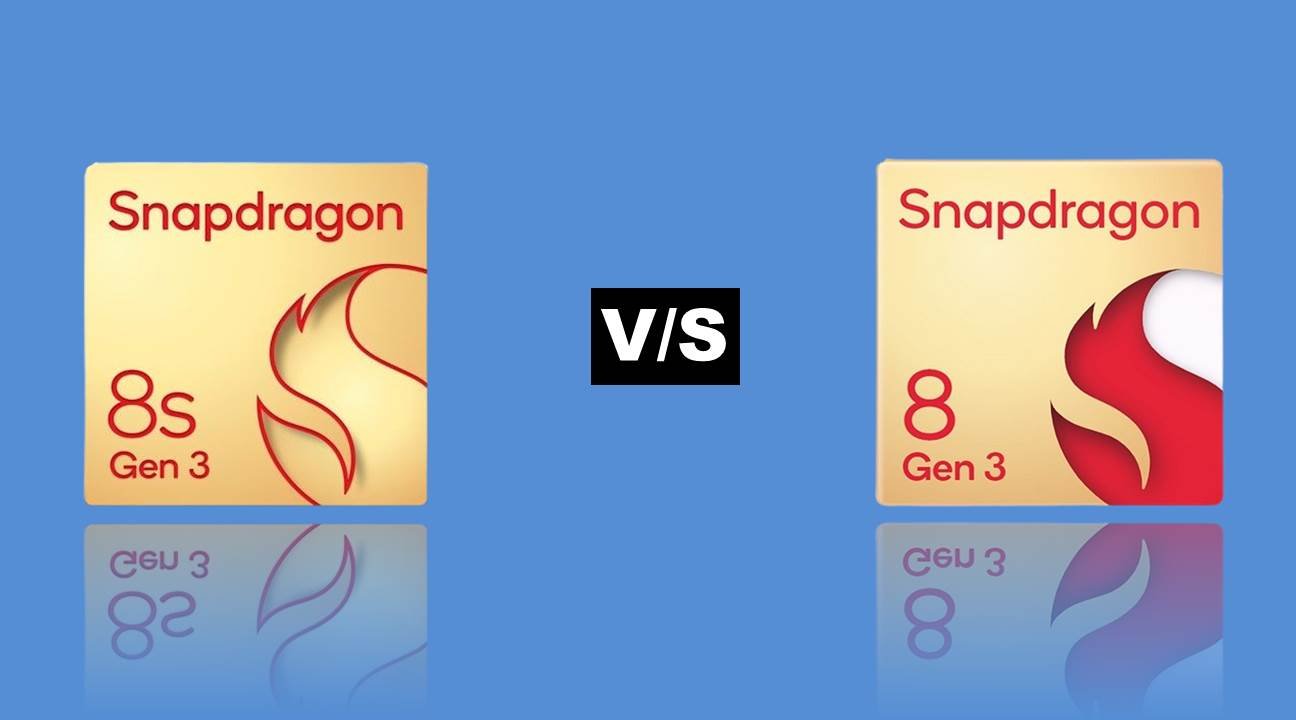
Qualcomm’s Snapdragon 8 Gen 3 has been the go-to flagship chip for premium Android smartphones since its debut, powering devices with cutting-edge performance, gaming prowess, and AI capabilities. But in a surprising move, Qualcomm introduced a slightly toned-down sibling — the Snapdragon 8s Gen 3 — aimed at delivering top-tier features in a more affordable package.
While their names might suggest only a subtle variation, the Snapdragon 8s Gen 3 and the Snapdragon 8 Gen 3 differ in several important areas. Let’s break down how these two chips stack up across performance, graphics, AI, imaging, and connectivity.
CPU Architecture & Performance
Both chips are built on TSMC’s 4nm process and use ARMv9 CPU cores, but the core layout and clock speeds show a clear performance hierarchy.
Snapdragon 8 Gen 3:
- Prime Core: 1x Cortex-X4 @ 3.3GHz
- Performance Cores: 5x Cortex-A720 (3x at 3.2GHz, 2x at 3.0GHz)
- Efficiency Cores: 2x Cortex-A520 @ 2.3GHz
Snapdragon 8s Gen 3:
- Prime Core: 1x Cortex-X4 @ 3.0GHz
- Performance Cores: 4x Cortex-A720 @ 2.8GHz
- Efficiency Cores: 3x Cortex-A520 @ 2.0GHz
This setup makes it clear: while the 8s Gen 3 still offers a strong octa-core configuration, it’s slightly underclocked compared to the flagship 8 Gen 3. You’ll still get solid multi-core performance for gaming and multitasking, but heavy-duty users will see a difference.
GPU & Gaming Performance
The GPU is one of the biggest differentiators between these two.
- Snapdragon 8 Gen 3 is equipped with the latest Adreno GPU, supporting hardware-accelerated ray tracing, global illumination, and Game Super Resolution for upscaling.
- Snapdragon 8s Gen 3 uses an earlier generation Adreno GPU, lacking some of the cutting-edge gaming features found in its flagship sibling.
While both GPUs support high frame rates and excellent visuals, gamers and graphics-intensive app users will benefit from the more powerful graphics pipeline of the Snapdragon 8 Gen 3.
AI Capabilities
AI is an increasingly important part of mobile chips, and both SoCs come equipped with Qualcomm’s Hexagon NPU.
- The Snapdragon 8 Gen 3 delivers more robust AI processing, including support for running generative AI models on-device, faster natural language processing, and more efficient power usage during AI tasks.
- The 8s Gen 3 features a scaled-back NPU, capable of powering AI features like camera enhancements, background blur in video calls, and on-device assistants — but lacks the same horsepower for running large AI models in real-time.
In real-world use, both chips are competent for most AI-driven tasks, but power users will notice quicker and more advanced performance on the 8 Gen 3.
Camera & Imaging
The Snapdragon 8 Gen 3 supports Qualcomm’s Cognitive ISP — a powerful triple 18-bit image signal processor that brings real-time semantic segmentation to photography and video.
- It supports photo capture up to 200MP, 4K HDR video at 120fps, and ultra-low light night photography.
- The 8s Gen 3 retains a similar ISP architecture but with toned-down support for features like semantic segmentation, and it may not support the same real-time video enhancements.
That said, the 8s Gen 3 still delivers excellent camera performance for most users, but content creators and photography enthusiasts will appreciate the advanced tools in the Snapdragon 8 Gen 3.
Connectivity Differences
Here’s where the two chips diverge quite a bit:
- Snapdragon 8 Gen 3 uses the Snapdragon X75 5G modem, supporting both mmWave and sub-6GHz networks with peak speeds of up to 10Gbps.
- Snapdragon 8s Gen 3 is equipped with the Snapdragon X70 modem, supporting up to 6.5Gbps — but with limited or no mmWave support, depending on implementation.
Both chips support Wi-Fi 7 and Bluetooth 5.4, ensuring they are future-ready in terms of wireless tech. But when it comes to ultra-fast 5G, the Snapdragon 8 Gen 3 has the upper hand.
Power Efficiency & Thermal Management
Thanks to its more modest clock speeds and scaled-back AI/GPU modules, the Snapdragon 8s Gen 3 is expected to run cooler and more power-efficient, especially under sustained load.
Devices using this chip might not only be more affordable, but also offer better battery life — an important consideration for daily users who prioritize longevity over raw performance.
Real-World Use Cases
Snapdragon 8 Gen 3 is ideal for:
- Gamers
- Content Creators
- Power Users
- AI Enthusiasts
- High-End Flagships
Snapdragon 8s Gen 3 is perfect for:
- Upper-midrange Android phones
- Users who want solid performance without the premium price
- Longer battery life and cooler temperatures
Final Thoughts
While the Snapdragon 8s Gen 3 shares a lot of its DNA with the Snapdragon 8 Gen 3, it is clearly designed for a different audience. It delivers flagship-level performance at a lower cost, making it a great choice for upper-midrange phones that don’t need to chase benchmark records.
The Snapdragon 8 Gen 3, on the other hand, is built for top-tier devices — where every bit of power, performance, and feature-richness matters.
In short: If you’re after the best of the best, go for the 8 Gen 3. But if you’re looking for premium performance on a budget, the 8s Gen 3 hits the sweet spot.
Explore our News Section for daily updates and the latest tech news. Join our WhatsApp Channel for instant updates.